“In a perfect world, I wanted to regain my freedom and peace. I wanted to live without control, fear, or violence and to feel safe and independent again.”
This is what domestic violence survivors in Uganda truly look for when they seek justice. They are often not looking for punitive measures or complex legal battles; they want practical, peaceful solutions that secure their safety. Yet, despite a progressive legal foundation on paper, including the landmark Domestic Violence Act of 2010, the gap between legal protection and real safety for survivors remains wide. Domestic violence is not a marginal issue in Uganda. It is a widespread and persistent crisis. HiiL’s 2024 Justice Needs and Satisfaction survey (JNS) revealed that four out of every ten adult Ugandan women experienced domestic violence in the previous year alone. When these disputes remain unresolved, the consequences are devastating. In 2025, the Uganda Police Force recorded 208 deaths linked directly to domestic violence.
HiiL’s latest report Bridging the Justice Gap: Actionable Solutions for Domestic Violence Survivors in Uganda, co-funded by the European Union and German Federal Ministry for Economic Cooperation and Development (BMZ), aims to bridge this divide by exploring the complex justice journeys of domestic violence survivors. Applying a people-centred justice (PCJ) lens, the report looks beyond institutional performance and focuses on what survivors need to be safe, heard, and able to move forward.
The systemic paradox: high respect, low safety
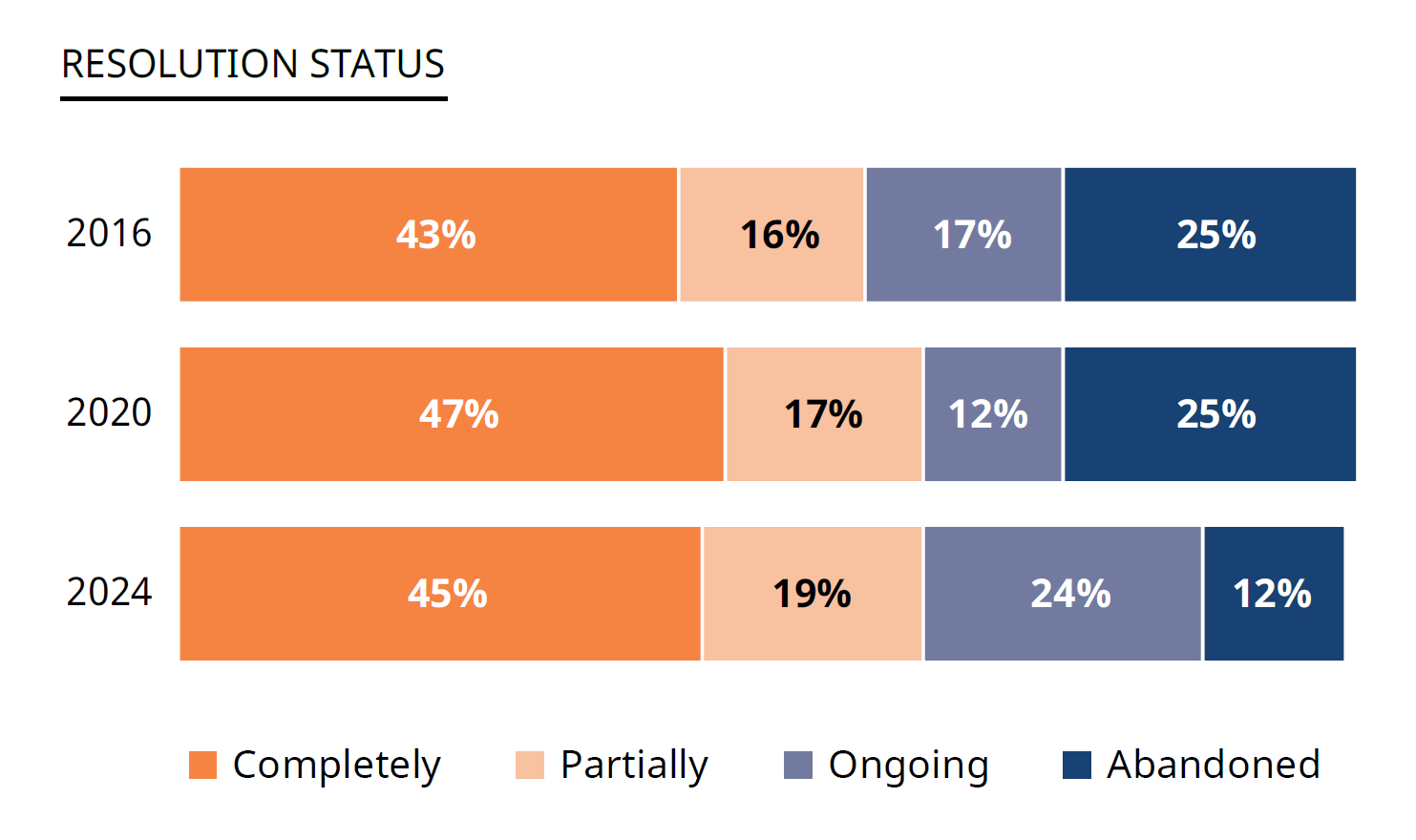
This study exposes a difficult contradiction at the heart of the current system. The survivors we spoke with frequently reported feeling that they had a genuine voice, were listened to carefully, and were treated with dignity. This is supported by the 2024 JNS, in which 67% of Local Council users with domestic violence problems and 66% of police users with domestic violence problems rated these providers as helpful or very helpful. However, while a respectful justice journey matters, justice falls short if survivors remain unsafe. The data revealed a significant gap between positive processes and successful resolutions. Across three JNS surveys (2016, 2020, 2024), complete case resolution rates remained between 43% and 47%. When speaking with survivors, many of those who had resolved their cases were unsatisfied with the outcome as it left them vulnerable to further violence. True people-centred justice must be measured by whether both the process and the outcome meet survivors’ needs, allowing them to safely move on with their lives, not simply by the closure of an administrative case file.
Unpacking the gaps: referral loops and systemic traps
Improving justice services starts with understanding where survivors get stuck, in both formal and informal systems. The interviews with survivors and providers highlighted three key bottlenecks:
Exhausting, vague referral loops
The justice journey for a domestic violence survivor is rarely linear. Instead of receiving clear guidance, survivors are often sent from one provider to another, from Local Councils and police units to medical facilities and community organisations, without anyone taking ownership of the case. The costs are heavy: transportation fees, lost wages, emotional exhaustion, and, too often, abandoned cases. As one survivor shared:
“I actually left the Local Council’s office more confused than when I arrived. When you are already stressed and overwhelmed, you need someone to guide you step by step, but instead I felt like I was being sent blindly to a place with no assurance of help or safety.”
The arrest paradox
Only four out of the 30 survivors interviewed explicitly wanted arrest and jail time for the perpetrator as the outcome. Choosing formal prosecution often means jailing the household’s main breadwinner, leaving the survivor to face, often devastating, economic consequences. Furthermore, there can be a lot of cultural and community pressure to avoid arrest, with survivors considered responsible for destroying their families if they have the perpetrator arrested. Faced with this choice, survivors often avoid formal escalation, remaining in unsafe situations so their families can survive economically.
The enforcement dilemma
To preserve community cohesion or manage formal case backlogs, both formal and informal justice providers often lean on swift reconciliations. These outcomes are typically formalised via written commitment letters or mediated apologies. However, informal justice providers (particularly Local Council Chairpersons and community leaders) lack the legal authority to compel compliance, while formal police units often lack the operational resources to monitor them. One Local Council Chairperson summarised this frustration clearly:
“We have no true power to do anything. Someone agrees to stop beating and then they break it, you can’t do anything.”
Consequently, perpetrators routinely reoffend, leaving survivors in dangerous cycles of abuse.
Co-designed, actionable solutions
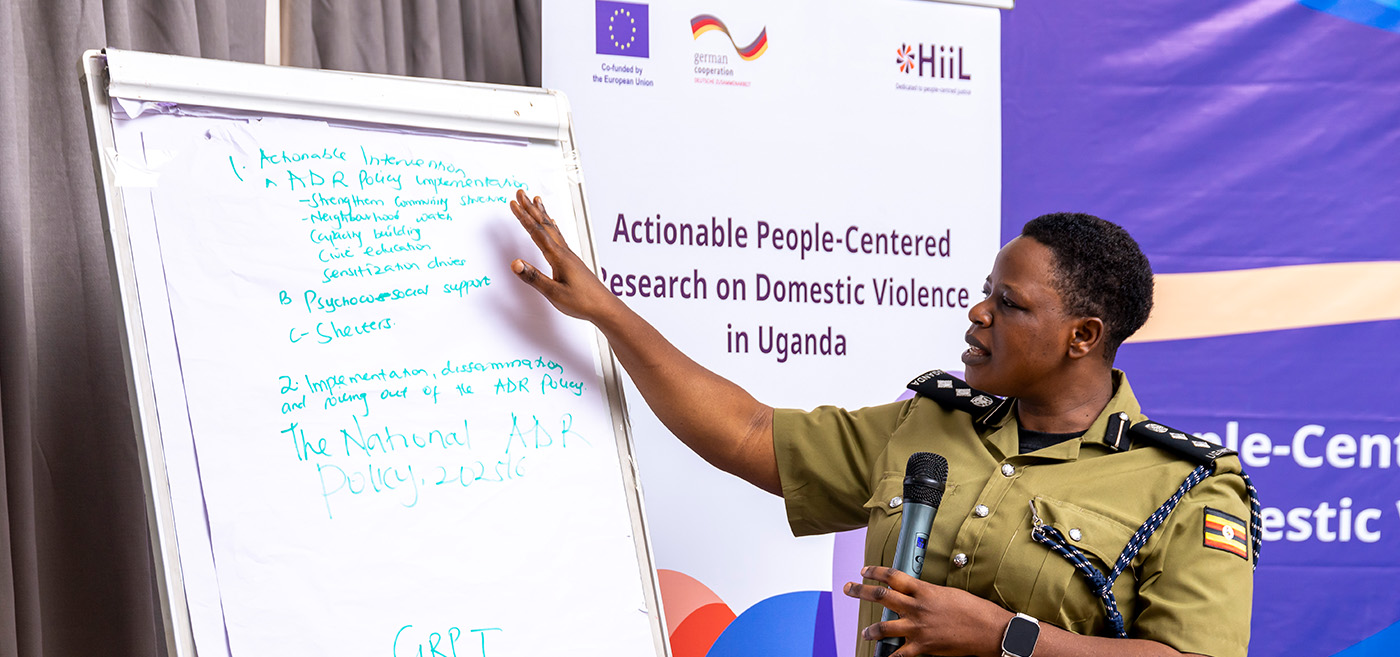
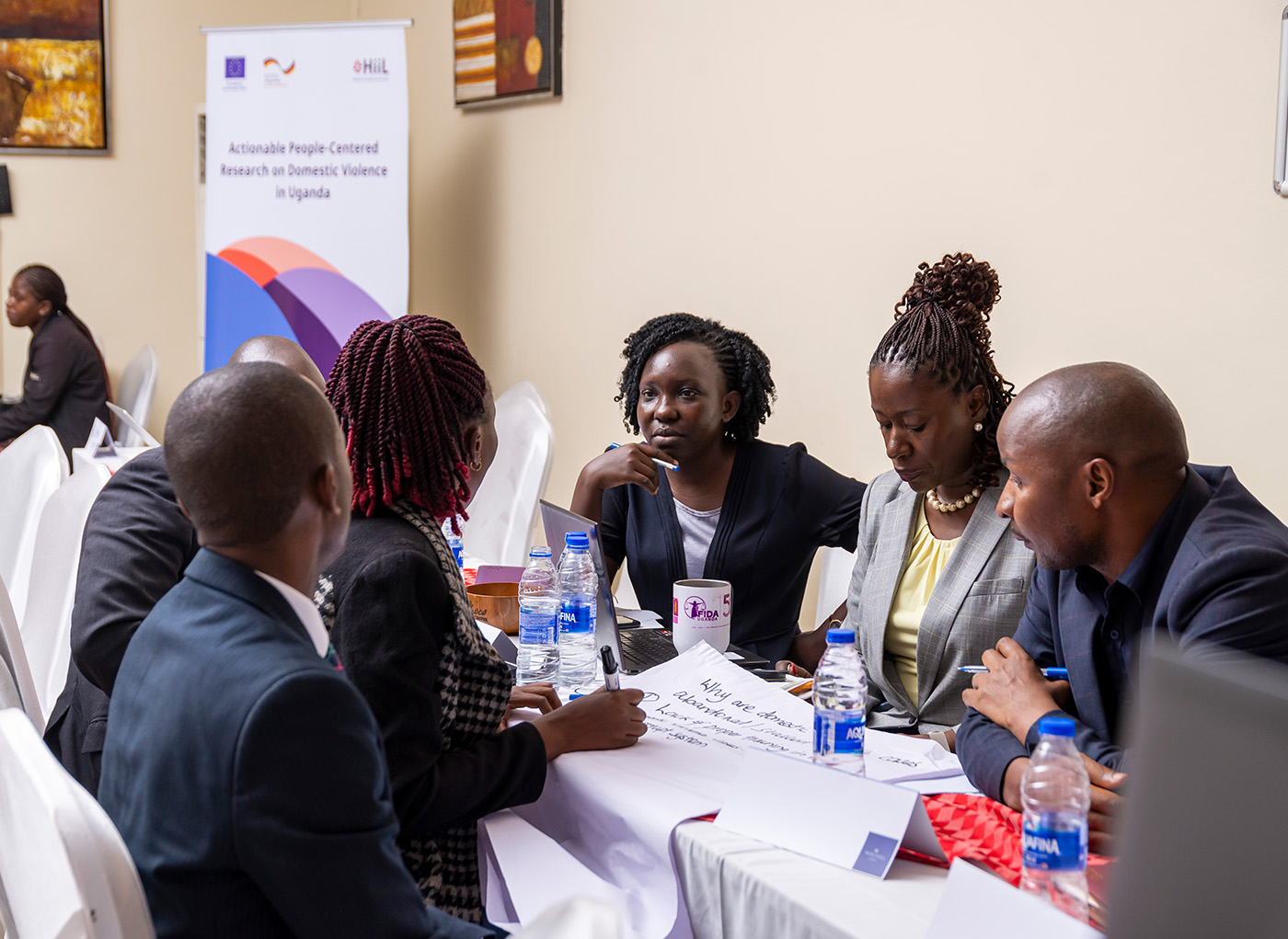
In March 2026, HiiL hosted two participatory workshops in Kampala, bringing together 26 informal justice practitioners and 17 formal justice representatives. Rather than simply viewing the data from afar, these local experts actively collaborated to understand the survivors’ experiences and brainstorm concrete, low-cost improvements to their daily services. The report translates these insights into strategic priorities for policymakers and innovators:
- Community Justice Hubs (“One-Stop Centres”): Piloting community-level hubs that integrate local administration, legal aid, and psychosocial support. By anchoring case ownership in a single location, survivors would be less likely to get lost in costly referral loops or abandon the process altogether.
- Standardising frontline justice provision with “Justice Toolkits”: Equipping local councils, elders, and frontline practitioners with clear, local-language guidelines to standardise trauma-informed care and clarify exactly when mediation might not be appropriate and formal system referral is necessary.
- Linking justice to economic empowerment: Explicitly integrating livelihood support, skills training, and startup capital into the justice response to begin removing the financial vulnerability that forces survivors to accept unsafe or undesired reconciliations.
- Standardising alternative dispute resolution (ADR) approaches: Capitalising on the national ADR policy to provide structured, ethical oversight to community mediation, ensuring agreements are legally binding, safe, and systematically monitored.
Download the full report
No survivor should have to choose between economic survival and a life free from violence. That is what people-centred justice must make possible. Closing the justice gap does not require designing and funding a brand-new justice system. It requires re-thinking and re-designing the existing systems to work exactly as intended. By equipping local providers with the right tools and centering the financial and physical realities of survivors, Uganda can transform its fragmented justice pathways into a cohesive, reliable safety net.
Download the full report here