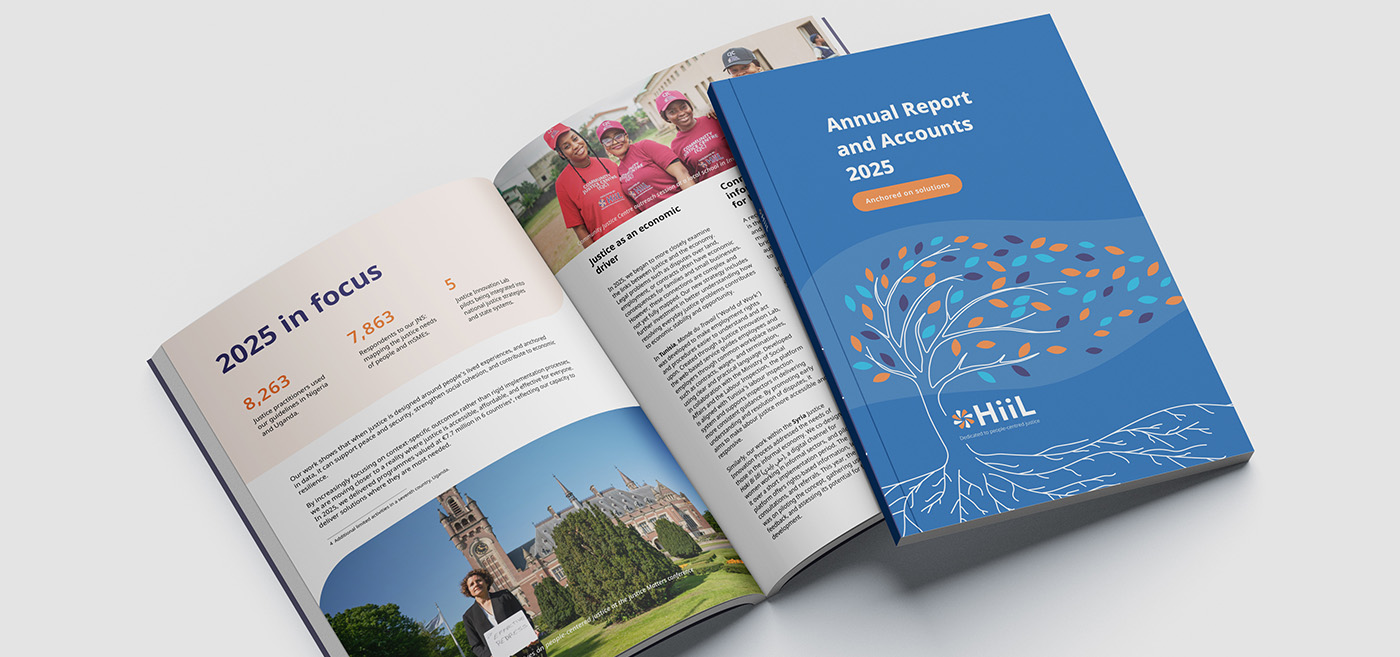
In a world marked by increasing instability, shrinking civic space, and a seventh consecutive year of global rule of law decline, one reality has become increasingly clear: justice cannot remain an abstract principle. It must work for people where they are, in the systems they trust and use every day. Today, HiiL launches its Annual Report 2025: Anchored on Solutions — reflecting on a year defined by adaptation, innovation, and measurable impact across Africa and the Middle East. The report demonstrates that people-centred justice is not only a human right; it is a foundation for stronger economies, resilient communities, and lasting peace.
In 2025, HiiL delivered €7.7 million in justice programmes across six countries, working alongside governments, civil society organisations, customary leaders, and local communities to close the justice gap and create sustainable solutions.
2025 at a glance
- €7.7 million in programmes delivered across 6 countries
- 8,263 justice practitioners in Nigeria and Uganda are using HiiL guidelines
- 87% of surveyed practitioners in Nigeria routinely apply HiiL tools in their daily work
- 5 Justice Innovation Lab pilots integrated into state systems and national strategies
- 7,863 respondents participated in Justice Needs and Satisfaction (JNS) surveys
- 200,000+ people reached in Syria through legal clinics, mediation initiatives, and AI-supported services
- 69 staff members representing 25 nationalities
Behind these numbers lies a simple principle: effective justice systems begin with understanding how people actually experience justice problems.
Working where people seek justice
In 2025, HiiL programmes were active across:
Tunisia • Syria • Nigeria • Ethiopia • Niger • Burkina Faso
Across these countries, a recurring lesson emerged: people frequently rely on community-based and customary systems rather than formal courts. In Ethiopia, 43% of disputes are resolved through customary mechanisms, often involving village elders. In Burkina Faso, only 4% of people use courts, while just 1% consult lawyers. Rather than replacing these systems, HiiL focused on strengthening the connections between formal institutions and the trusted community structures people already turn to. The result is justice that becomes faster, more accessible, and closer to home.
Innovation with impact
Innovation remained central to HiiL’s work in 2025, not as technology for technology’s sake, but as practical tools solving real-world problems. In Niger, the Hadin kai–bani fondo platform introduced voice-assisted legal support for rural communities, helping customary leaders access validated legal guidance during land dispute mediation. In Syria, HiiL-supported partners piloted “Haki Be Eidi”, a digital legal assistant supporting informal workers and vulnerable communities. More than 200,000 people were reached through legal clinics, mediation initiatives, and digital tools. Across multiple countries, innovations increasingly moved beyond pilot stages. Five Justice Innovation Lab solutions have now been integrated into national systems, transforming experimental projects into sustainable public goods.
Stories behind the statistics
Data tells one part of the story. Individual experiences reveal the human impact behind it.
In Niger, Saouda, a widowed mother of five, lost access to her late husband’s farmland after relatives claimed ownership. Through awareness campaigns and community engagement by HiiL-supported organisations, she learned about her rights and regained access to her land. In Ethiopia, Amredin, an electrician facing an escalating neighbour dispute that threatened his livelihood, turned to elder-led mediation through a Community Justice Centre. The conflict was resolved in six days, allowing him to return to work and restore stability for his family. In Burkina Faso, Thérèse’s experience of being denied inheritance rights highlighted a broader challenge surrounding customary land rules. Through HiiL’s Justice Innovation Lab, oral traditions were transformed into a written local land charter, creating greater legal certainty and transparency for communities.
These stories reinforce a larger insight: justice problems affect livelihoods, family stability, health, and economic opportunities.
A new chapter: From “Design and Drop” to “Design and Deliver”
The Annual Report also marks an important turning point for HiiL with the launch of its 2026–2029 Strategy. For years, HiiL focused on designing and testing solutions. The next phase builds on those lessons by ensuring solutions remain embedded and sustainable over time. The new strategy moves from a “design and drop” model to a “design and deliver” approach, accompanying governments and partners through implementation, scaling, and institutionalisation. The shift reflects a broader ambition: moving beyond ideas toward long-term systems change. As justice challenges become increasingly interconnected with economic resilience, social cohesion, and security, the need for practical and people-centred solutions has never been greater.
The 2025 Annual Report demonstrates that those solutions already exist, and that when justice is anchored in local realities and evidence, meaningful change follows.