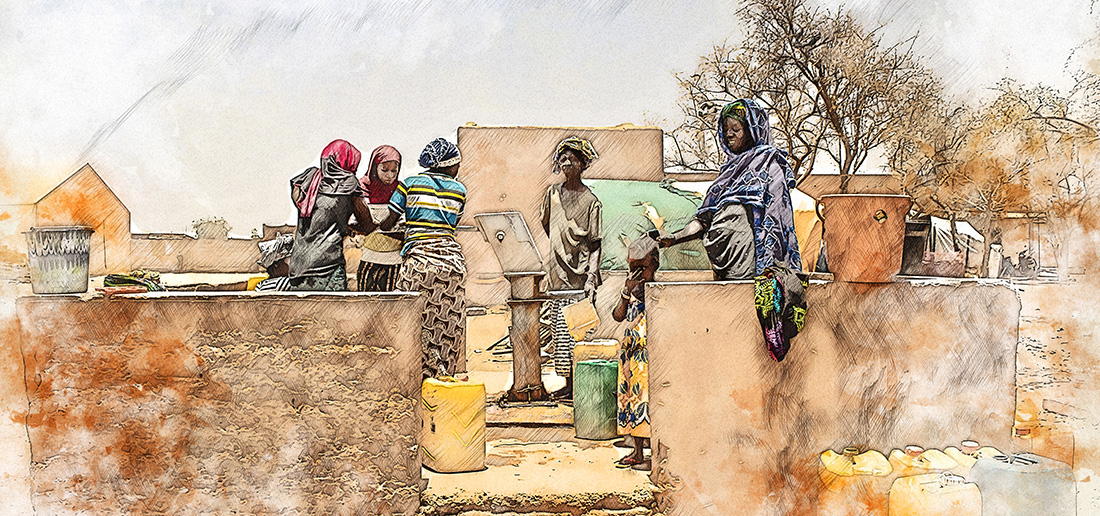
In Burkina Faso’s most insecure regions, access to justice is no longer defined primarily by courts or formal procedures. It is shaped by displacement, institutional withdrawal, and the capacity of communities to manage disputes in the absence of stable state presence. A new study by HiiL, in collaboration with Dr Habibou Fofana and national partners, examines how justice is actually experienced in five conflict-affected areas: Nouna, Fada N’Gourma, Bogandé, Diapaga, and Dori.
Based on 330 interviews and 20 focus group discussions conducted under highly constrained security conditions, the research maps how individuals and communities resolve disputes, seek accountability, and maintain social order in contexts where formal justice systems are partially or fully inaccessible. The findings highlight a justice landscape that is fragmented but not absent, where formal institutions, customary authorities, and ad hoc community mechanisms operate in parallel, often compensating for each other’s limitations. Rather than focusing solely on institutional collapse, the study documents how justice systems are being reconfigured under pressure, and what this means for legitimacy, trust, and social cohesion.
Key Findings
- Justice access is increasingly shaped by survival conditions rather than legal entitlements
Insecurity, displacement, and poverty determine whether people can access justice at all. Even routine administrative services (e.g. certificates, documentation, and complaints procedures) often require travel through unsafe areas or reliance on intermediaries. - Court relocation has created systemic bottlenecks and reduced the visibility of justice
The physical withdrawal of courts from insecure regions has led to delays across the justice chain, including hearings, investigations, and enforcement. This has contributed to growing perceptions of institutional absence, even where formal structures technically remain in operation. - Displacement is reshaping local conflict dynamics and increasing pressure on local resources
Tensions between internally displaced persons and host communities are rising, particularly around land, water, and livelihoods. These disputes are often managed informally, but the scale of pressure is exceeding traditional mediation capacity in some areas. - Social cohesion functions as an informal justice infrastructure
Trust between communities has become a key determinant of whether disputes escalate or are resolved. In contexts where institutions are weak, social relations act as stabilising mechanisms or as risk multipliers for conflict. - Community-based mechanisms are absorbing a significant share of dispute resolution
Traditional leaders, religious authorities, elders, mediators, and local dialogue platforms play a central role in resolving disputes and maintaining order. These mechanisms are not substitutes for formal justice but have become essential components of the justice ecosystem. - Digital and remote justice innovations are emerging, but remain uneven and constrained
Courts and justice actors are experimenting with videoconferencing and remote communication to maintain continuity. However, connectivity gaps, legal uncertainty around digital proceedings, and uneven access limit scalability.
Adaptation Without Equality – What Burkina Faso teaches us
What the Burkina Faso case makes clear is that justice systems in conflict settings do not simply “break down.” They redistribute their functions across whatever structures remain viable: state institutions that operate at a distance, customary authorities working under pressure, and communities absorbing increasing responsibility for dispute resolution. This redistribution is not neutral. It reshapes who has authority to decide disputes, which norms are applied, and whose access to remedies becomes conditional on geography, trust, or social position. In other words, justice does not disappear in crisis settings, but changes form, and with it, the boundaries of accountability.