Today, as we mark the United Nations Day dedicated to empowering Micro-, Small and Medium-sized Enterprises (MSMEs) through innovation and sustainable industrial development, we recognise the critical role small businesses play in building resilient and inclusive economies.
MSMEs represent more than 90% of businesses worldwide and contribute significantly to employment, livelihoods, and economic growth. They are essential drivers of local development, particularly for women, young people, and vulnerable communities. As economic, social, environmental, and technological challenges continue to intersect, strengthening MSMEs has become central to achieving Sustainable Development Goal 9 (Industry, Innovation and Infrastructure) and accelerating progress toward the 2030 Agenda. Yet innovation is not only about digital tools, infrastructure, or industrial growth. It is also about building institutions that work better for people, including justice systems. For many businesses, especially smaller enterprises, legal disputes can become major barriers to survival and growth. Contract disputes, debt-related challenges, regulatory conflicts, and administrative burdens often create costly disruptions that prevent businesses from scaling sustainably.
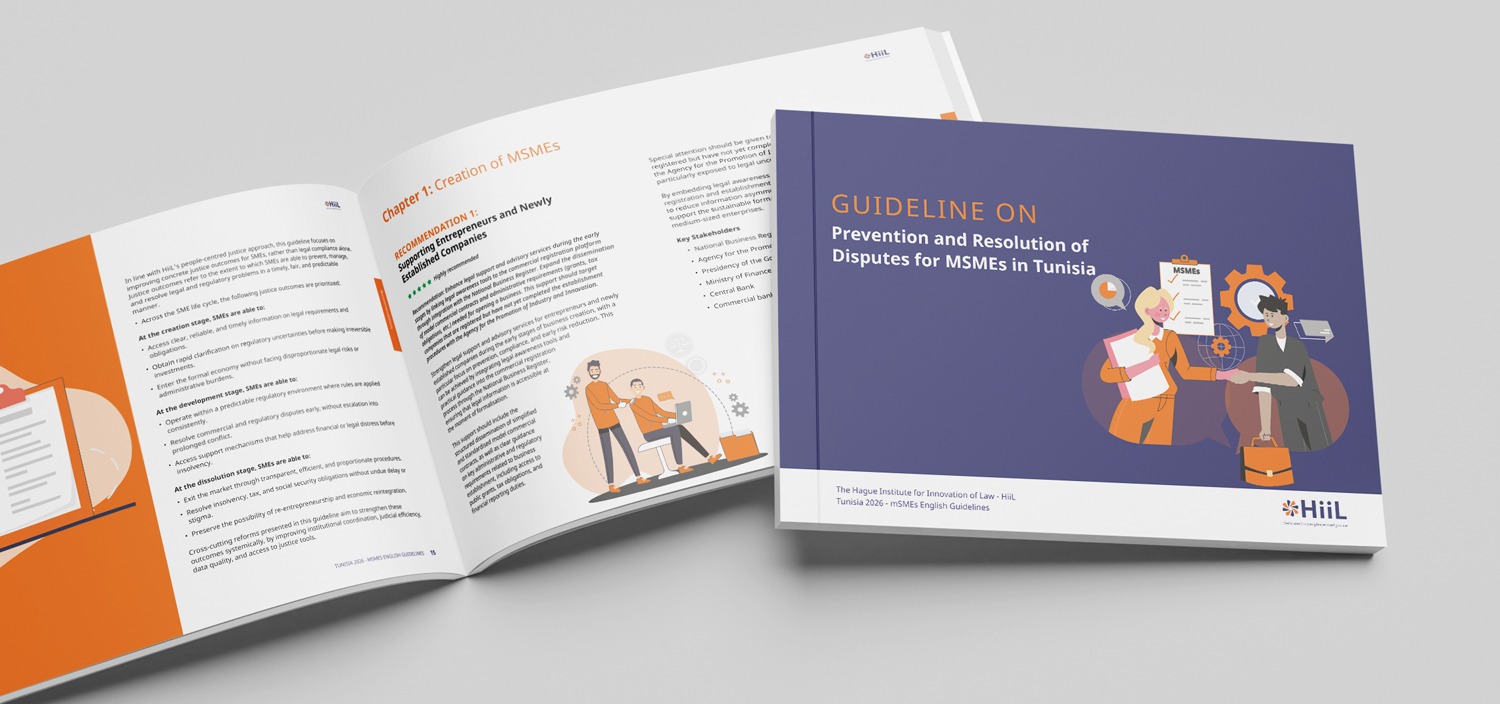
In observance of the United Nations Day dedicated to Micro-, Small and Medium-sized Enterprises, HiiL is emphasising the vital link between legal institutional health and economic prosperity by presenting our Guideline on Prevention and Resolution of Disputes for MSMEs. This actionable framework provides a roadmap for enterprises to mitigate legal risks, settle disagreements at an early stage, and fortify operational stability.
The Justice Gap Facing Tunisian MSMEs
HiiL’s 2025 Justice Needs and Satisfaction (JNS) survey found that more than half of formal-sector Tunisian MSMEs experienced at least one serious legal problem within the past two years. The most common issues were contractual disputes (51%), debt or financing problems (36%), and competition-related disputes (26%). Rather than pursuing formal justice mechanisms, many business owners rely on informal negotiations or absorb the losses themselves, reflecting persistent barriers such as limited accessibility, high costs, procedural complexity, and low trust in institutions. For MSMEs, unresolved disputes create more than legal challenges; they generate economic vulnerability. They undermine business confidence, discourage formalisation, and weaken investment. Improving access to justice is therefore not only a legal priority but also a critical driver of economic development.
A People-Centred Approach to Business Justice
To respond to these challenges, HiiL worked with a committee of Tunisian experts from both the justice sector and the MSME ecosystem. Combining local expertise with international evidence, the resulting guidelines identify practical, context-sensitive interventions to improve dispute prevention and resolution. The framework follows the lifecycle of an enterprise: creation, development, and dissolution.
Creation: Preventing Problems Early
The early stages of a business often determine its long-term resilience. Yet many entrepreneurs enter the formal economy without sufficient legal guidance, increasing their exposure to administrative and compliance-related disputes. The guidelines recommend integrating legal support directly into Tunisia’s National Business Register (RNE), ensuring entrepreneurs receive clear administrative and legal guidance from the outset. Continued digitisation of legal procedures through a unified online portal would also simplify compliance and reduce early-stage disputes. The goal is simple: prevent problems before they emerge.
Development: Supporting Sustainable Growth
As businesses grow, so do their legal and operational risks. A predictable and accessible justice environment becomes essential for sustainable expansion. One major recommendation is the standardisation of contract templates, particularly in Tunisia’s traditional crafts sector, which employs around 11% of the national workforce. Informal verbal agreements often lead to payment delays and delivery disputes, disproportionately affecting artisans, 85% of whom are women. Additional recommendations include establishing accessible mediation centres for MSMEs, expanding mobile-friendly tax systems, improving employment contract guidance, and deploying digital risk-alert tools that help businesses identify financial stress before it escalates. These interventions reflect a broader principle: sustainable industrial development requires systems that reduce uncertainty and support business continuity.
Dissolution: Creating Fair Exit Pathways
Not every business succeeds. But business failure should not automatically result in permanent exclusion from economic life. The absence of structured exit mechanisms often leaves entrepreneurs trapped in unsustainable debt, pushing many into informality. To address this, the guidelines propose structured debt relief and economic reintegration pathways for entrepreneurs acting in good faith. They also recommend an early warning system that uses signals such as delayed tax filings or returned cheques to identify businesses at risk before collapse becomes inevitable. This shifts the focus from reacting to failure to preventing irreversible damage.
Justice as Infrastructure for Economic Resilience
Supporting MSMEs requires more than access to finance, markets, and technology. It also requires institutions that enable businesses to operate with confidence, resolve disputes efficiently, and recover from setbacks. This is where justice innovation becomes essential. The barriers facing MSMEs are rarely caused by a lack of laws. More often, they stem from fragmented information, procedural complexity, and systems that are difficult to navigate. Addressing these challenges requires justice systems that are more accessible, responsive, and people-centred. As the global community recognises the role of MSMEs in building sustainable and inclusive economies, Tunisia offers an important lesson: economic resilience depends on justice resilience.
By strengthening dispute prevention and resolution, entrepreneurs are better equipped to innovate, invest, and grow.