By Zainab Malik and Adedolapo Alabi
Women judges don’t just fill seats; they transform justice systems to work for the people they serve.
Around the world, 5.1 billion people lack meaningful access to justice. When legal problems go unresolved – whether family disputes, land conflicts, workplace discrimination, or violence- the consequences ripple far beyond individual hardship. Unresolved justice problems can escalate into community conflict, erode trust in institutions, and contribute to broader social and political instability. They also carry a significant economic cost, preventing people from working, investing, and protecting their livelihoods. Yet for millions of people, justice systems remain difficult to navigate, slow to respond, or disconnected from the realities of everyday life. Evidence from HiiL’s Justice Needs and Satisfaction surveys reveal that many people facing legal problems never access justice mechanisms.
Closing this justice gap requires justice systems that are designed around the needs and lived experiences of those they serve. Justice systems are fundamentally shaped by the perspectives and priorities of those who design and lead them. When those perspectives lack diversity of lived experiences, the system develops blind spots. The composition of the bench is, therefore, much more than a matter of fairness, it is a critical design decision that influences how justice is delivered.
The International Day of Women Judges offers a moment to reflect not only on representation, but also on the transformative role women judges play in shaping justice systems that are fair, effective and more responsive to people’s needs. Grounded in the OECD Recommendation on Access to Justice and people-centred Justice systems, this approach – known as people-centred justice – prioritises systems that are accessible, inclusive, responsive, practical and focused on outcomes rather than procedures.
While increasing the number of women on the bench is a starting point, the real value lies in the Diversity Dividend: the idea that representative leadership delivers better outcomes. For the justice sector, this means that more women judges can transform courts that are distant and intimidating into responsive service providers.
The Diversity Dividend in Action
Women judges strengthen justice systems by broadening judicial perspectives, building public trust, and driving institutional reform. Research from the IDLO demonstrates that their leadership does more than satisfy a human rights requirement. It improves the quality of judicial decision-making, along with the accessibility and responsiveness of court processes. Women judges also play a key role in mentoring the next generation of legal professionals, and champion reforms making justice more responsive to marginalised communities.
We see this “Diversity Dividend” in action in Kenya. Under the leadership of Chief Justice Martha Koome, the Judiciary of Kenya pioneered a vision of Social Transformation through Access to Justice (STAJ). STAJ aims to transform the judiciary into an active driver of social cohesion and constitutional change, measuring success by outcomes such as protecting rights, promoting inclusive economic participation, and closing the justice gap. The program brings justice closer to communities through satellite courts, mobile courts, and e-filing systems, while digital and infrastructure investments reduce travel time and costs for vulnerable litigants.
Women judges have also shaped the development of gender-responsive international jurisprudence, particularly in cases involving sexual violence during armed conflict. For example, at the international criminal tribunals for Rwanda and the former Yugoslavia, women judges like Judge Navanethem Pillay and Judge Elizabeth Odio Benito played important roles in ensuring that rape and gender-based violence were recognised and prosecuted. Reforms they championed, limiting the use of prior sexual history as evidence and strengthening witness protection, pushed international courts toward a more victim-centred approach to justice.
Beyond reforms, the presence of women judges also improves the quality and legitimacy of legal outcomes. Courts that reflect the societies they serve are often perceived as more approachable and trustworthy. When marginalised groups see themselves represented in the judiciary, they may feel more confident seeking formal justice for sensitive issues such as domestic violence or workplace harassment. Women leaders are often the first to identify “invisible” barriers that male-dominated legal circles might overlook. An example is the recognition of “Sextortion”—the use of sexual favours as a currency for corruption. This form of exploitation went largely unnamed until women judges, through the International Association of Women Judges (IAWJ), identified it as a specific, systemic barrier to justice.
Shaping Justice From the Start
The influence of women in justice must extend upstream to frameworks that shape how justice is delivered from the very beginning. Constitutional design often sets the foundation and limits for the promotion of people-centred justice. It determines whether an enabling legal and institutional framework is in place to systematically prioritise the needs of users, monitor institutional performance with user needs data, foster and scale justice innovations, recognise diverse resolution pathways and ultimately ensure that they truly serve people. It is often the first step in what the OECD Recommendation, under Pillar 1, calls establishing a people-centred purpose and culture. Increasingly, women are contributing to these processes as constitution-makers, legal experts, and judicial leaders. This is especially critical during periods of constitutional reform or political transition, when decisions about rights and accountability can shape justice systems for generations.
Join our Webinar
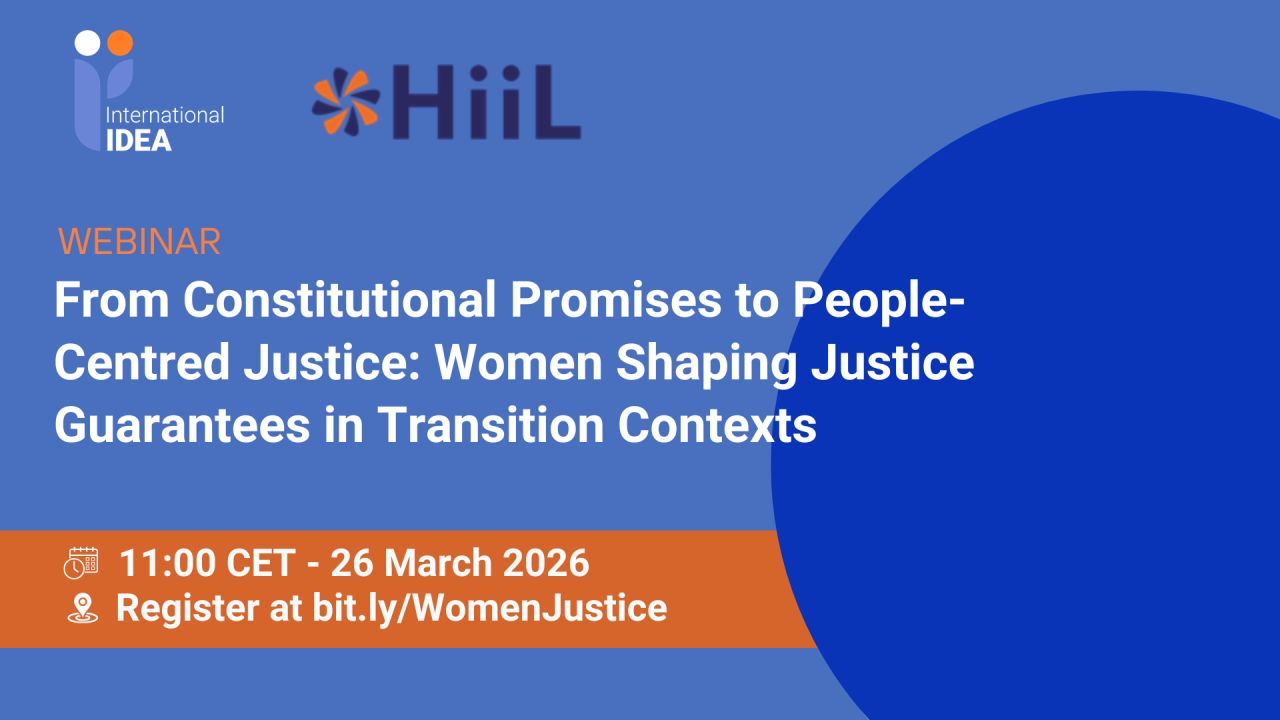
To explore this, HiiL, in partnership with International IDEA, is organising an upcoming webinar: From Constitutional Promises to People-Centred Justice: Women Shaping Justice Guarantees in Transition Contexts. Taking place on March 26, 2026, from 11:00 – 12:30 (CET), the session will draw on the experiences of women constitution-makers and judges on how people-centred justice can be embedded into constitutional frameworks, especially in transitional contexts.
As we mark the International Day of Women Judges, it is time to move beyond the idea that gender diversity is a “nice-to-have.” It is a technical necessity. Closing the global justice gap and fulfilling the promise of people-centred justice requires the perspective, innovation, and leadership that women judges bring. We don’t just need more women on the bench; we need the transformative justice they deliver.
📅 Register: https://buff.ly/toR2GwD