HiiL is pleased to announce the publication of its latest report, “A people-centred solution to improving access to justice in Imo State, Nigeria.”
The report documents the establishment and early operation of the Community Justice Centre (CJC) in Owerri, Imo State, tracing its development from a data-driven design in a Justice Innovation Lab to a functioning, community-based justice service. It offers a grounded account of what it takes to translate people-centred justice from design to delivery.

The Justice Gap: Demand Without Access
The report opens with a stark finding: 71% of people in Imo State experience a new legal problem every four years, most commonly related to land, family, and financial disputes. Despite this high prevalence, formal legal institutions, courts and lawyers, are engaged in only 18% of cases. Qualitative interviews conducted for the study point to a consistent set of barriers: cost, complexity, fear of escalation, and lack of trust. For many justice seekers, formal processes are perceived as inaccessible or socially disruptive. As one interviewee explained, remaining silent often feels like the least harmful option.
This gap between legal need and legal access forms the core problem the Community Justice Centre was designed to address.

Clinic day at the Community Justice Centre in Imo State, Nigeria
The Community Justice Centre Model
The Community Justice Centre operates as a first point of contact within the justice system, providing free legal information, advice, and mediation. Developed through one of HiiL’s Justice Innovation Labs, the CJC model is explicitly non-competitive: it does not replace courts, police, or traditional dispute resolution mechanisms. Instead, it integrates into the existing justice ecosystem, guiding users toward appropriate pathways while resolving a significant proportion of disputes at an early stage.
The report highlights how this approach aligns with justice users’ priorities. In many cases, individuals are less concerned with formal legal victory than with outcomes such as preserving family relationships, maintaining community cohesion, or avoiding prolonged conflict. The CJC model is designed around these user-defined justice needs.
From Design to Implementation: Lessons from the Pilot
A central contribution of the report is its analysis of the transition from concept to practice. Initially envisioned as a government-led model implemented across 53 locations, the pilot in Imo State required significant adaptation in response to political change, security constraints, and resource limitations.
Key lessons examined in the report include:
- Sustainability and Financing: While pro bono contributions enabled the pilot phase, the report identifies this as unsustainable at scale. It explores the introduction of a means-based cost structure, allowing limited fees for those who can afford them to cross-subsidise free services for vulnerable users.
- Public Legal Education and Outreach: The “Justice Voice” radio programme emerged as a critical access channel. Beyond directing justice seekers to the CJC, it functioned as a preventive tool by improving legal awareness and reducing the escalation of disputes.
- Institutional Integration: For the CJC model to scale and maintain legitimacy, mediated outcomes must be legally recognised and enforceable. The report therefore underscores the importance of formal government engagement and institutional anchoring.
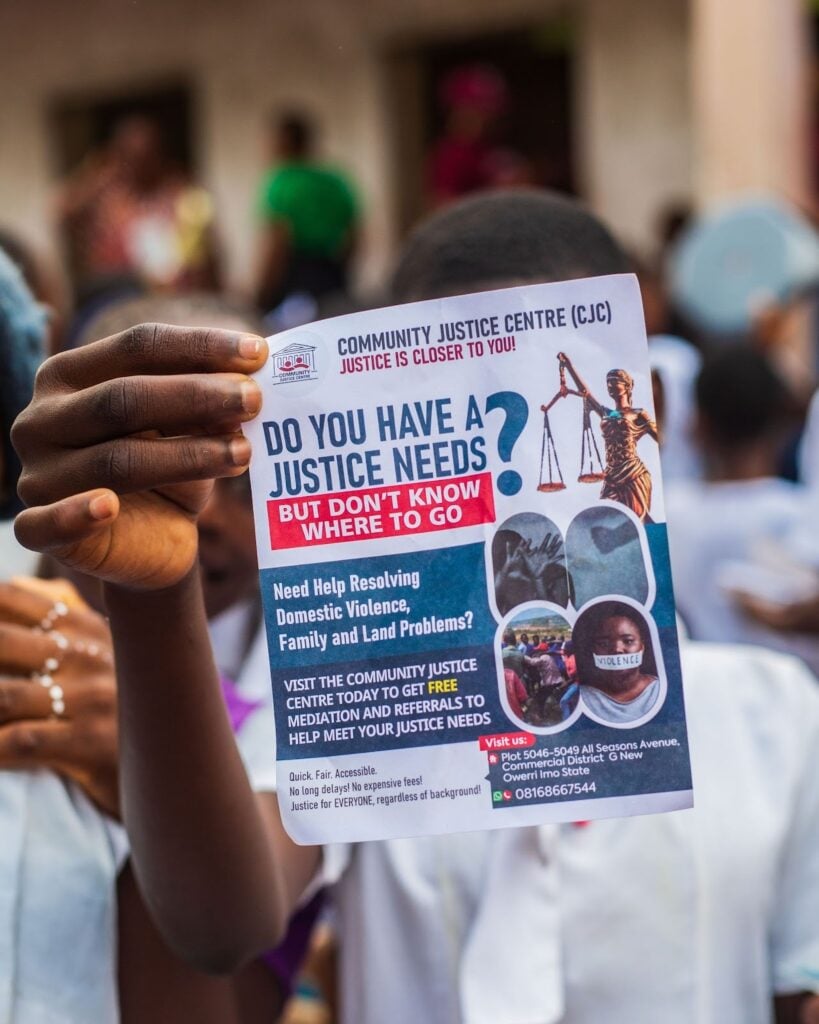
Caption: The Community Justice Centre outreach session at a local school in Imo State
Co-Creation and Local Ownership
The report concludes that the CJC’s early effectiveness is closely linked to its collaborative governance structure. Traditional authorities, judicial actors, civil society organisations, and community representatives were engaged through an iterative co-creation process rather than a top-down rollout. This approach fostered local ownership and operational autonomy. The local Steering Committee has since taken responsibility for convening and financing its own meetings, an early indicator of institutional sustainability beyond external project support.
What the Report Offers
Readers will find:
- Qualitative insights from justice seekers, justice providers, and steering committee members
- An evidence-based roadmap for scaling the CJC model across Imo State
- A user-centred justice framework, defining justice in terms of outcomes that matter to people, not solely formal legal resolution
The Imo State case study demonstrates that people-centred justice is not only a design principle but an operational strategy. One that requires institutional flexibility, local partnership, and sustained investment. This report contributes to the growing evidence base on people-centred justice innovation in low-access contexts and offers practical guidance for policymakers, donors, and practitioners seeking to close the justice gap in Nigeria and beyond.
Read the full report here